
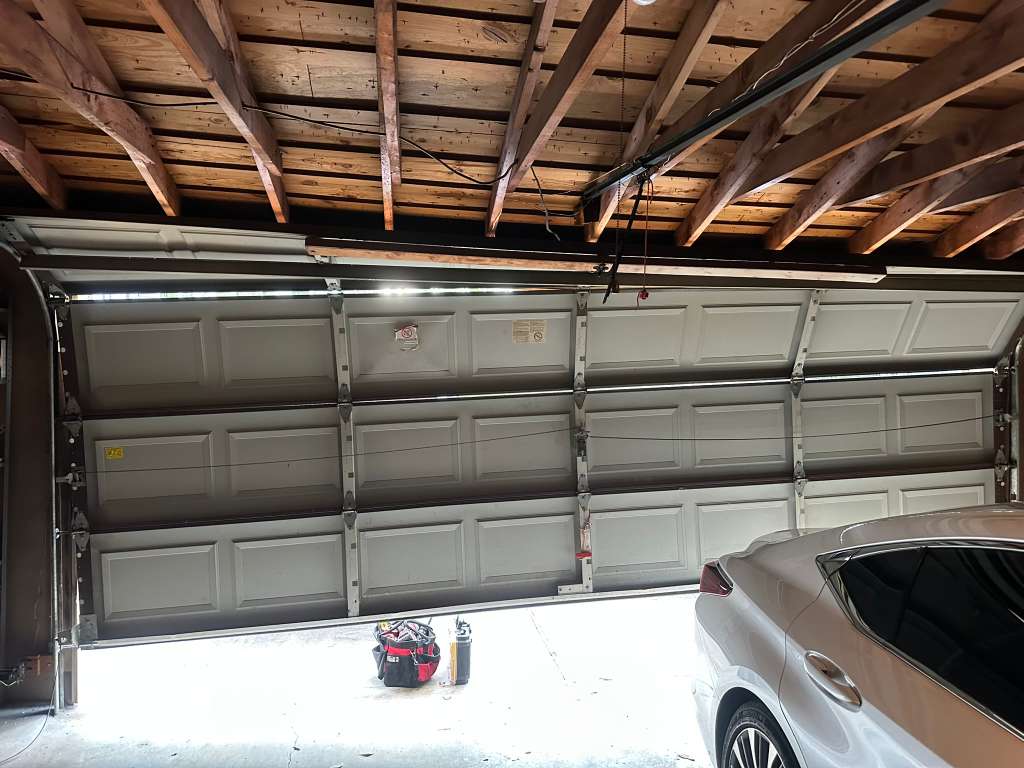
It’s 6:47 AM. You backed your car halfway out, the door started to close, and now it’s hanging crooked off one side of the track with the spring dangling above it like a dead snake. You have to be at work in 40 minutes. The neighbor’s curtains are twitching. The dog is losing his mind.
This is what an emergency garage door looks like for most of our customers. It’s not a slow-motion failure with weeks of warning — it’s a sudden mechanical event that turns your morning routine into a small crisis.
Here’s the playbook. What to do in the first 5 minutes. What NOT to do. When “same-day repair” actually means same-day. And what to expect when the tech actually shows up.
The first 5 minutes: do this
In order:
-
Move people and pets back. A door that’s already failed once can fail again — a spring that snapped can fall, a cable that broke can whip. Get everyone behind you, not under the door.
-
Don’t keep pressing the opener button. Each cycle past a real problem makes the damage worse. A roller out of track might be a $150 fix. The same roller after you tried to force it five more times can rip the bottom panel and turn into a $600 repair.
-
Look at the door from a few feet back. Is it crooked? Is one side higher than the other? Is the bottom panel bent? Is there a cable hanging loose? Is a spring visibly snapped above the door? Each of these tells you something different about how dangerous it is to touch.
-
Pull the red emergency release rope — but only if the door is fully closed or fully open. If it’s stuck halfway and you’re not sure why, do NOT pull the release. A door that’s being held up by a failed spring or jumped cable can come down hard the moment you release the opener. The opener is the only thing keeping it up.
-
Call us. From a phone you can still get to — i.e. not the one trapped in your garage. Our dispatcher will ask you 3 or 4 questions to figure out exactly what’s wrong and how urgent it is.
The first 5 minutes: do NOT do this
-
Don’t try to push the door back onto the track. Tracks under spring tension can shift unpredictably, and the door weighs 150–400 lbs. People get hurt this way every week somewhere in the country.
-
Don’t try to wind a torsion spring yourself. This is the single most dangerous thing you can do with a garage door. Pros use specific winding bars, drum brakes, and PPE. A slipped winding bar at full tension can crack a skull. It’s not “I have the right tools” — it’s “this is a job that requires training, and the consequences for getting it wrong are severe.”
-
Don’t drive the car out under a partially-stuck door. If something gives way while the car is under it, you’ll be filing two claims instead of one.
-
Don’t ignore burning smells. If the opener motor is humming, smoking, or smells hot, unplug it from the ceiling outlet immediately. Forcing a motor past a real obstruction is how openers catch fire.
When you actually need emergency service vs. morning service
Not every problem is a true 911. Here’s how we triage at dispatch:
Genuine emergency (we send someone within 90 minutes)
- Door is stuck OPEN and you can’t close it — your house is unsecured
- Door is stuck CLOSED with your car trapped inside and you have to leave
- Door fell off the track and is hanging crookedly — risk of falling
- Spring broke audibly and the door is making noises like it might come down
- Storm damage — a tree branch came through, a wind gust bent the door, etc.
- Someone tried to break in and the door is damaged
Same-day but not 911 (we’ll be there today, just not in 90 min)
- Opener stopped working but the door is closed and your car is out
- Remote stopped working but the wall button still does
- Door is grinding or noisy but still functional
- Spring is fine but a roller or cable looks worn
Next-day or scheduled (book at your convenience)
- Door is a little slow but works
- Cosmetic damage that doesn’t affect function
- You’re shopping for a new door for curb appeal
A good dispatcher will tell you straight up which bucket you’re in. We do. If you call us and your situation is bucket #3, we’ll tell you it can wait until tomorrow — we’re not going to charge you an emergency premium for a non-emergency.
What “same-day” actually means (the dirty secret)
Most garage door companies that advertise “same-day service” mean “sometime today if we have a tech open up.” Often that’s 6 PM after a full day of scheduled jobs. By then your morning is ruined and you’ve taken a half day off work.
Here’s what real same-day looks like:
- Live dispatcher — not an answering service that takes a message and texts a tech. A human who can actually see the schedule and tell you a real ETA.
- Reserved emergency slots — we hold 1–2 slots open every day specifically for emergency calls. They don’t get booked unless an actual emergency comes in.
- Fully stocked trucks — the tech has the parts on the truck, so it’s one trip not three. Springs, cables, openers, rollers, hinges, bottom seals, the works.
- Realistic ETAs — we tell you “60 to 90 minutes” and we hit it. If we won’t, we call you proactively, not when you call to check.
If a company can’t promise all four, “same-day” is marketing language, not a real service.
What happens when the tech arrives
Here’s the exact flow:
1. They look at the whole door first, not just the broken part. A snapped spring isn’t a snapped spring in isolation — it’s usually a sign of a system that’s been worn for a while. The tech walks the whole assembly: springs, cables, drums, rollers, hinges, tracks, bottom seal, opener. The 12-point inspection takes about 8 minutes.
2. They give you a written, itemized quote. Before they touch a tool. Itemized means each part and labor line is listed. You see the price, you approve in writing (electronically — we don’t carry triplicate paper forms in 2026), the work begins.
3. Most repairs happen in one visit, in 45–90 minutes. Spring replacements: about 60 minutes. Cable replacements: 45. Off-track door: 30–60 depending on damage. Opener replacement: 60–90. Panel replacement: 1.5–2 hours.
4. They test the entire door before leaving. Up. Down. Up. Down. Safety reverse test (a foot under the closing door to make sure it bounces back). Force sensitivity test. Limit switches. If anything is off they fix it before they pack up.
5. They explain what to watch for going forward. “Your other spring has about 18 months of life left at your usage rate. We’ll send you a reminder text 60 days before it’s likely to fail.” That kind of thing. Real maintenance partnership, not a one-and-done.
The 4 most common emergencies, and what actually caused them
In order of how often we get called:
1. Broken torsion spring (~45% of emergency calls)
Almost always wear-related. Builder-grade springs are rated for 10,000 cycles. Average family uses the door 4 times a day = 1,460 cycles a year = spring failure around year 7. Cold weather accelerates this — most of our spring calls in NY and Cleveland come in January.
2. Door stuck open (~20%)
Usually a sensor issue (something blocking the photo eyes), a travel limit out of adjustment, or a broken opener gear. About a third of the time you can fix it in 60 seconds with a wipe of the sensor lenses. The other two-thirds need a tech.
3. Cable broke and door is crooked (~15%)
Cables fail from rust, drum wear, or sudden shock loading when a spring breaks. They tend to fail together — if one cable went, the other is on borrowed time. We replace both as a pair, every time.
4. Off-track door (~10%)
Caused by a broken cable, a worn roller that jumped out, or impact (a car bumper, a kid’s bike, a falling object). Forcing the opener to keep cycling once a door starts to come off the track is the #1 way “small fix” becomes “full panel replacement.”
The other 10% is everything else: smashed panels, opener motor failure, ice-frozen seals, vandalism, storm damage.
How to prevent future emergencies
Honestly, most garage door emergencies are predictable months in advance. The door tells you it’s struggling before it fails — most homeowners just don’t notice. Here’s what to watch for:
Quarterly (every 3 months):
- Pull the red release rope and lift the door by hand. It should feel light and stay open at half-height. If it feels heavy or wants to close on its own, spring tension is fading.
- Spray garage-door-specific silicone lubricant on rollers, hinges, springs, and cables. Not WD-40 — that’s a solvent that strips lubrication.
- Look at the springs for visible gaps in the coils. A gap = days or weeks from breaking.
Annually:
- Have a pro do a tune-up. About 20 minutes, catches everything you can’t see (frayed cable strands, hairline hinge cracks, bearing wear).
- Replace the bottom rubber seal if it’s cracked or compressed flat.
- Test the safety reverse: put a 2x4 flat under the closing door. It should bounce back the moment it touches.
Before winter (October/November):
- Extra lubrication on everything — cold makes lubricants stiffen.
- Replace the bottom seal if it’s worn — frozen seals stuck to concrete are the #1 cold-weather emergency call.
- Confirm spring balance — winter doubles the load on a spring already losing tension.
A 30-minute quarterly checkup catches ~80% of failures before they happen. The 30 minutes you spend lubricating in October prevents the 5 AM January spring snap that costs you a sick day and an emergency fee.
When in doubt, call us
If you’re not sure whether what’s happening with your door is a real emergency or just an annoyance — call. Our dispatchers are trained to triage on the phone, and we won’t oversell you on emergency service if you don’t actually need it.
(855) 634-5995. Or request a callback online and we’ll text you back within 15 minutes.
We work across all 3 of our cities 7 days a week, with reserved emergency slots every single day. If your door is broken right now, we can probably have someone at your house before lunch.