Garage door problems we repair
A garage door is a system of balanced parts under high tension — springs, cables, rollers, tracks, hinges, the opener, and its safety sensors. When one part wears or fails, the symptom you notice is often downstream of the real cause. These are the most common repair calls we handle across Queens and Long Island:
Door won’t open
Often a broken torsion spring, a tripped or unplugged opener, a failed capacitor, or a snapped cable. If the opener strains and the door barely moves, stop and call — forcing it can cause more damage.
Door won’t close
Usually the safety sensors (misaligned, dirty, or obstructed), a travel-limit setting, or a track obstruction. A door that reverses before it reaches the floor is almost always a sensor or limit issue.
Crooked or off-track door
A door hanging at an angle or jammed in the tracks is a safety hazard. Do not operate it. A roller, cable, or bracket has usually let go on one side.
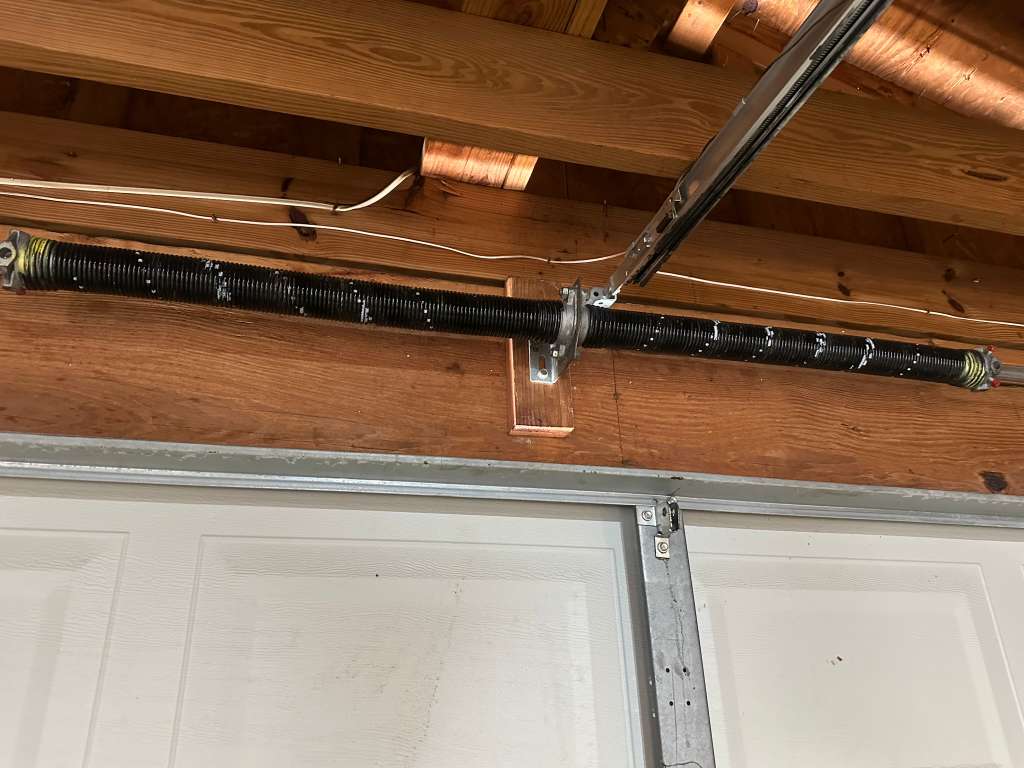
Broken spring
A loud bang from the garage and a door that’s suddenly too heavy to lift is a classic broken torsion spring. The opener was never designed to lift the full dead weight of the door.
Snapped or frayed cable
Lift cables run alongside the tracks under constant tension. A frayed or snapped cable lets one side drop and can throw the door off its tracks.
Worn rollers & hinges
Cracked rollers and loose hinges cause grinding, binding, and uneven travel. Replacing them restores smooth, quiet operation and protects the tracks.
Noisy or rough operation
Grinding, squealing, or banging usually traces to dry or worn rollers, loose hardware, an unbalanced door, or an opener nearing failure.
Damaged panels
A dented or cracked section from a bump or weather can sometimes be replaced as a single panel; when damage is widespread, replacement is the better long-term value.
Opener problems vs. door problems
It’s easy to blame the opener when a door misbehaves, but the two are separate systems. The opener is the motor unit, logic board, drive (chain, belt, or screw), travel limits, safety sensors, remotes and wall control. The door is everything mechanical: springs, cables, rollers, tracks and hinges. A door that is hard to lift by hand has a door problem the opener cannot fix; a door that moves freely by hand but won’t respond to the remote has an opener problem. We test both so you don’t pay to replace a working opener because of a bad spring — or vice versa. For opener-specific issues, see our garage door opener repair page.
How we diagnose the problem
Our process looks at the door as one balanced system rather than chasing the loudest symptom:
Safety & balance check
We disconnect the opener and test the door’s balance and travel by hand.
Component inspection
Springs, cables, rollers, tracks, hinges, sensors and opener are checked for wear and failure.
Clear estimate
We explain the cause and the repair options, and give you the price before any work.
Approved repair & test
We complete the work you authorize and re-test the full system, including safety reversal.
Repair or replace? An honest answer
Most garage door calls are a repair, not a replacement. A single failed spring, cable, roller, or opener part is a straightforward fix that restores the door for years. Replacement becomes the smarter investment when damage is structural or repeated:
| Usually a repair | Consider replacement |
|---|---|
| Broken spring or cable on an otherwise sound door | Multiple panels cracked, dented, or rotting |
| Worn rollers, hinges, or noisy hardware | Repeated failures across different components |
| Opener motor, gears, sensors, or remotes | Heavy rust, water damage, or an obsolete door |
| Off-track door with intact sections | You want better insulation, security, or curb appeal |
We’ll tell you honestly which side your door falls on. If replacement is the better value, see new garage door installation.
Garage door safety: what to do right now
A garage door is the largest moving object in most homes, and its springs and cables store enough energy to cause serious injury. If your door is behaving abnormally:
- Stop using the opener if the door is heavy, crooked, or straining — you can worsen the damage or derail the door.
- Don’t attempt spring or cable work yourself. Torsion springs are under extreme tension and are the most dangerous part to service.
- Keep children and pets clear of a door that is stuck open, off-track, or partially hanging.
- If the door is stuck open and your home is exposed, call for emergency garage door repair.
Brands we service
We repair common residential garage door and opener systems, including doors from Clopay, Amarr, Wayne Dalton and C.H.I., and openers from LiftMaster, Chamberlain and Genie.
Garage door repair in Queens
Queens is our home base. We handle residential garage door repair across the borough — Forest Hills, Flushing, Fresh Meadows, Jamaica, Bayside, Whitestone, Astoria, Long Island City and nearby neighborhoods — for attached garages, detached garages, and the single-car doors common on Queens blocks. See our Queens garage door service page for local details.
Garage door repair in Nassau & Suffolk
On Long Island we focus on Nassau County and Suffolk County, where double-car and insulated doors are more common. Whether it’s a broken spring in Nassau or an off-track door in western Suffolk, call with your ZIP code and we’ll confirm availability. See Long Island garage door service, Nassau County, and Suffolk County.
Before your appointment
To speed things up, have your ZIP code ready, a short description of what the door is doing, and the opener brand if you know it. A photo of the problem area helps. If the door is unstable, leave it closed (or safely open) and keep the area clear until the technician arrives.
Frequently asked questions
How quickly can I get garage door repair?
Same-day appointments may be available for many repair calls when scheduling allows and depending on your ZIP code. Call as early in the day as possible for the best chance of same-day service.
Will I know the price before any work starts?
Yes. We diagnose the door, explain the cause, and give you a clear estimate. Work only begins after you approve it.
Is it safe to keep using a door that is acting up?
No. A door that is crooked, suddenly heavy, grinding, or hanging unevenly can fail under spring or cable tension. Stop operating it and call for repair.
Do you repair the opener as well as the door?
Yes. We service the door hardware (springs, cables, rollers, tracks, hinges) and the opener system (motor, gears, sensors, remotes, wall controls) for common residential brands.
Should I repair or replace my garage door?
Most single-component failures are a straightforward repair. Replacement makes more sense with structural panel damage, repeated failures, or significant rust or rot. We explain both options honestly before you decide.