
A grinding garage door is not a noise. It’s a warning.
Garage doors are well-designed pieces of equipment. When everything is working — springs balanced, rollers turning, hinges aligned, opener tuned — a good residential door is so quiet you barely hear it from the next room. So when yours suddenly sounds like a coffee grinder full of bolts, something is failing. The question is which something, and whether you can keep operating the door safely while you figure it out.
The short answer is almost always no, you shouldn’t keep operating it. A door that has just started grinding is days or weeks away from a bigger failure — and the bigger failure is usually a snapped spring, a cable that whips off the drum, or a panel that gets crushed when the door comes off-track. Replacing a roller costs a little. Replacing a panel because a roller froze and tore the door apart costs a lot.
Here are the 7 most common reasons a garage door grinds, what to do about each, and how to tell which one is yours.
1. Worn or dry rollers
The most common cause by a wide margin. Garage door rollers are small wheels on each side of every panel that ride up and down inside the track. Cheap builder-grade rollers are made of plastic with a tiny steel bearing inside. They wear out in 5–10 years and start dragging instead of rolling.
How it sounds: A consistent grinding or scraping that follows the door as it travels, sometimes with a metallic squeal.
What to do: Lubricate the rollers and tracks with a garage-door-specific silicone or lithium spray (never WD-40 — it’s a solvent, not a lubricant, and makes things worse long-term). If the noise quiets down for a few days then returns, the rollers are toast. Replacement is fast and cheap if you book it before they seize. We replace builder-grade rollers with sealed nylon bearings on every garage door repair call — they last 15+ years and run silent.
2. Bent or misaligned track
Tracks are the long metal channels on each side that the rollers run inside. If a track gets bent — by a car backing into it, by movement of the garage frame as the house settles, or by an impact during operation — the rollers fight the bend and grind their way past.
How it sounds: Grinding that only happens at one specific point in the door’s travel, often the same height every time.
What to do: Open the door manually (with the opener disengaged) and look down the track from one end. It should be perfectly straight. If you see a bulge, dent, or twist, the track needs adjustment or replacement. This is not a DIY job — bent tracks under spring tension can shift unpredictably when loosened.
3. Dry hinges
There’s a hinge between every pair of panels on a sectional garage door — typically 7 to 12 hinges on a residential door. They flex every time the door bends through the curve. Over time the steel pins inside wear, and the friction creates a creaking or grinding that sounds like it’s coming from “the whole door.”
How it sounds: A creaking, popping, or grinding that happens at the bend in the track — usually about 3 feet off the ground — and stops as soon as the door is fully open or closed.
What to do: Inspect each hinge for visible cracks (especially at the corners), then lubricate the pivot pin with garage-door spray. If the noise persists or you see any cracks, replace the cracked hinges. Cracked hinges are one of the most overlooked failure points and can let a panel sag out of alignment, which then snowballs into a bigger repair.
4. The opener is fighting an unbalanced door
This is the one that usually catches people off guard. The garage door opener is not actually designed to lift the weight of the door — the springs are. A balanced door should be liftable by hand with one finger. The opener just guides it up and down. When a spring weakens (long before it actually breaks), the opener starts taking on the full weight of the door and the motor strains, the chain or belt grinds, and the whole assembly sounds like it’s about to explode.
How it sounds: Heavy mechanical grinding from the opener motor itself, often with the door moving slower than usual.
What to do: Pull the red emergency release rope (only if the door is in the down position). Lift the door manually. If it feels heavy, fights you, or won’t stay up halfway on its own, your springs are failing. Stop using the opener until they’re replaced — every cycle you run with a weak spring shortens the life of your opener and risks the chain or belt snapping.
5. Loose or worn opener chain / belt drive
Older chain-drive openers stretch over time, and the chain rattles, slaps, and grinds against the sprocket. Belt-drive openers can fray or come off the pulley. Both make distinctive noises.
How it sounds: A metallic rattle or slap (chain) or a fluttering vibration (belt) coming specifically from the rail above the door, not from the door itself.
What to do: Most openers have an adjustment to re-tension the chain or belt. Check the manual for the model. If the chain has visibly stretched or the belt is fraying, replacement is straightforward. If your opener is 10+ years old and noisy, a modern quiet belt-drive replacement is usually a better investment than a repair.
6. A failing torsion spring (before the snap)
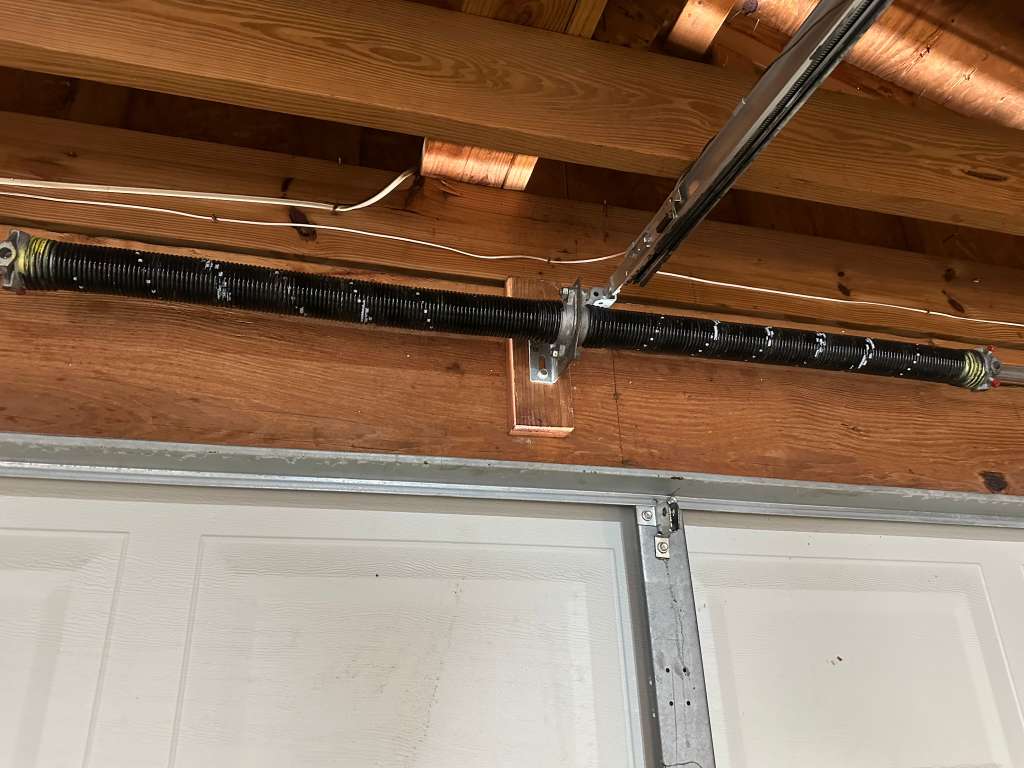
Torsion springs — the long horizontal springs above the door — don’t always snap silently. Sometimes they grind, pop, and groan for days or weeks before they break. The coils start to lose their grip on each other and the spring sounds like a giant unhappy slinky.
How it sounds: A deep grinding or growling from the shaft above the door, often accompanied by the door moving slower or pausing partway up.
What to do: Stop using the door. A spring that’s pre-announcing its failure is dangerous — when it does snap, it does so under hundreds of pounds of force, often whipping the cable off the drum and slamming the door down. This is a same-day call for a pro. We carry replacement springs on every truck and can usually be there within 90 minutes — see our spring replacement service.
7. Cables fraying or jumping the drum
The lift cables are the steel cables on each side of the door connecting the bottom panel to the spring drums up top. If they fray, kink, or partially jump off the drum, they bind against the housing and grind during operation.
How it sounds: A grinding or grating sound on one side only, sometimes accompanied by the door hanging slightly crooked.
What to do: Visually inspect the cables on both sides of the door. If you see frayed strands, kinks, or the cable wrapping unevenly on the drum, stop using the door immediately. A cable that’s about to fail will let go suddenly and the door can slam shut. Cable replacement is a same-day fix and we always replace both at once — they have the same wear life.
When to stop using the door immediately
Continue using your door if you only hear minor squeaking that goes away after lubrication. Stop using your door immediately if you notice any of:
- The grinding gets louder with each cycle
- The door moves slower or hesitates
- The door hangs crooked or won’t go fully up or fully down
- You see fraying cables, cracked hinges, or visible spring gaps
- The opener motor strains, hums, or smells hot
A garage door is the largest moving object in your house. When it goes wrong, it goes wrong fast — and the repair window between “minor fix” and “full panel replacement” is often days, not weeks. If you’re in any of our service areas, we can get a technician to you the same day, give you a free written quote, and stop the small problem from becoming the big one.
Need help today? Call us at (855) 634-5995 or request a free estimate and we’ll text you back within 15 minutes.