
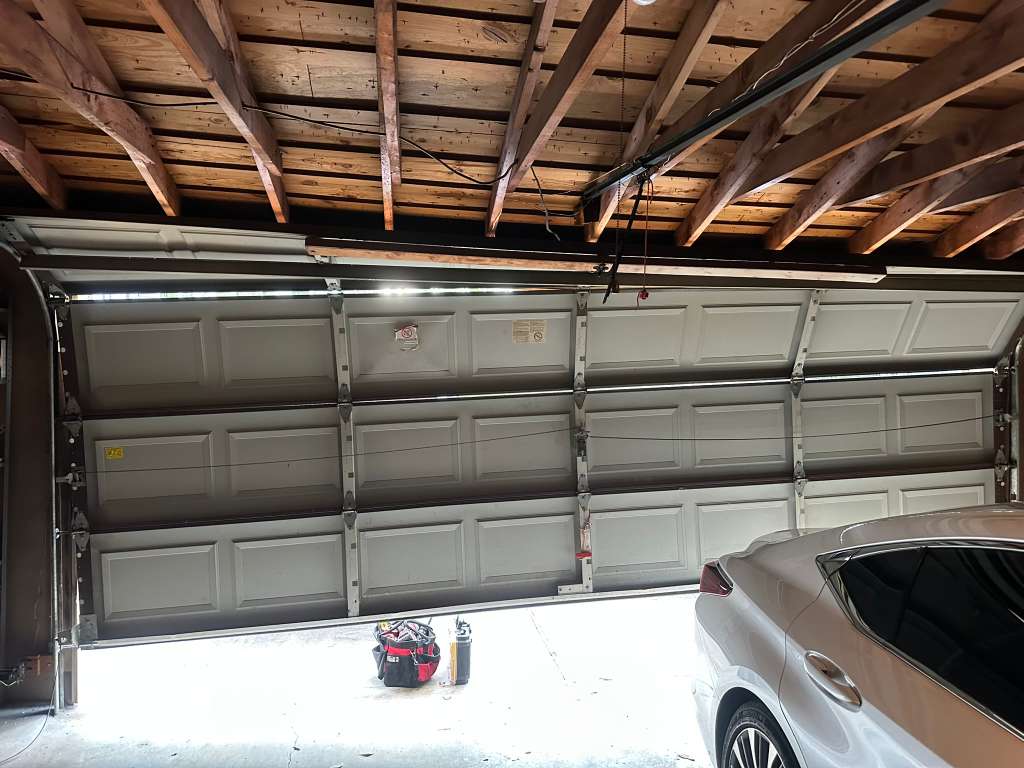
A garage door that won’t close is one of the most stressful failures in a home. Your house is open. Your car, tools, and whatever else is in there are exposed. It’s getting dark. The door reverses every time you try, the opener beeps angrily, and the dog is barking.
Take a breath. The good news is that in about 70% of these cases, the fix is something you can do yourself in under 5 minutes with no tools. Here’s how to diagnose what’s wrong, ranked roughly from easiest to hardest fix.
1. Something is blocking the safety sensors
The first thing to check. Every garage door opener installed since 1993 has two small “eyes” — photo-electric safety sensors — mounted near the bottom of the tracks on each side. They shoot an invisible beam between them. If the beam is broken or the sensors are misaligned, the door will refuse to close (it will start to close and then reverse and the opener light will blink).
Check this first: Look at the two sensor eyes. One should have a steady green light, the other a steady red (or sometimes both green — depends on brand). If either is blinking or off, the sensors are out of alignment.
Quick fix: Wipe both sensor lenses with a soft cloth — even a spider web or a bit of dust can break the beam. Then make sure nothing is in the path between them — a broom handle, a stray rake, a pile of leaves blown in by the wind. Last, check that the sensors are pointing directly at each other. They mount on adjustable brackets and can get bumped out of alignment by a kid’s bike or a garbage can. Loosen the wing nut, point them at each other until both LEDs go steady, and tighten back down.
Fixes the problem about half the time.
2. The travel limit is set wrong
Every opener has a “down limit” setting that tells it how far the door should travel before stopping. If this gets out of adjustment — common after a power outage or battery backup swap on newer openers — the opener thinks the door is hitting the ground before it actually is, reverses thinking it hit an obstruction, and goes back up.
How to spot it: The door comes down, gets very close to the floor (within an inch or two), then reverses and goes back up. No blinking sensor lights. Opener doesn’t make a struggling sound — just a normal travel-then-reverse cycle.
Quick fix: Most openers have a “down travel” adjustment knob or button on the motor unit. Check your manual (or search the model number online — most are on YouTube). You’ll turn the limit a small fraction in the “lower” direction and re-test. Don’t crank it — go in 1/8 turn increments.
If you have a wall-mount LiftMaster or newer Chamberlain MyQ opener, the limits are usually re-set via a button sequence on the unit itself. Older Genie units have a small dial.
3. The down force is set too low
Separate from the travel limit, every opener has a “force” setting — how much resistance it will tolerate before assuming it’s hit an obstruction. If this is set too sensitively, the friction of the door’s own weight near the bottom is enough to trigger a reverse.
How to spot it: Door reverses when it hits the floor or just before. Sensor LEDs are fine. Travel limits look right.
Quick fix: Find the “down force” adjustment (separate from the down travel adjustment) and increase it slightly. Again, small increments — 1/8 turn at a time, testing between each adjustment. If you have to crank the force way up to get the door to close, stop — there’s a real obstruction or balance problem you’re forcing past, which is dangerous.
4. Something is mechanically blocking the door
Less obvious than a broom in front of the sensors. Could be:
- A roller has come out of the track on one side, causing the door to bind partway down
- The bottom seal has caught on something (an extension cord, a frozen puddle of water in winter, a piece of debris)
- A cable has jumped off the drum and the door is hanging slightly crooked
- The track on one side has been bumped out of alignment and the door is grinding past it
How to spot it: Look up at the door as it tries to close. Does one side travel further than the other? Is the door visibly crooked? Is there any visible binding or scraping at a specific spot?
Quick fix: If you can see and identify the obstruction (debris, frozen water, etc.), clear it. If the problem is mechanical — a cable off the drum, a misaligned track, a roller out of place — stop trying to close the door. Forcing it can rip the bottom panel, bend the track, or snap a cable. Time to call a pro for garage door repair.
5. The bottom seal is damaged or compressed
Garage doors have a rubber gasket (the “astragal”) along the bottom that compresses against the floor when the door closes. If this seal is torn, rotted, or compressed in a way that wedges into the threshold, the door can either fail to seal or read it as resistance and reverse.
How to spot it: Door closes fully and the opener doesn’t complain, but there’s a visible gap between the door bottom and the floor, or the seal is visibly cracked, missing chunks, or hanging loose.
Quick fix: Bottom seals slide into a retainer on the bottom of the door and are replaceable in about 20 minutes with no tools beyond soapy water (to lubricate the new seal so it slides in). Replacement seals cost $20–40 at any home improvement store. If yours is shot, replace it — a worn seal also lets in cold air, rodents, and water.
6. A broken spring or cable
This is the worst case, and the one you don’t want to ignore. If you’ve checked all of the above and the door:
- Feels extremely heavy when you try to lift it manually (with opener disengaged)
- Has a visible gap in the torsion spring above the door
- Has a frayed or dangling cable on either side
- Slammed shut violently after the spring “let go”
…then a spring or cable has failed. Don’t keep trying to use the opener — every cycle damages the opener motor and risks the door coming off the track or the second spring snapping.
This is a same-day call. Emergency garage door repair — most repairs done in one visit, written quote before any work.
What to do tonight if you can’t close the door
If it’s late, you’ve tried the safety checks, and you can’t get the door fully closed:
- Pull the red emergency release. It disengages the opener so you can manually move the door.
- Lower the door by hand as far as it will go. If you can get it within a few inches of the floor, that’s much better than leaving it open.
- If the door is stuck partially open, prop it with a sturdy support — never trust the springs alone to hold a partially-open door if you suspect a spring or cable failure.
- Lock the interior door from the garage into the house. Many people forget this is even an option.
- Call us in the morning (or right now — we have 24-hour dispatch). We’ll get someone there same-day.
When to call instead of DIY
Call a pro if:
- You’ve checked the sensors, limits, and forces and the door still won’t close
- You see visible damage to a cable, spring, panel, or track
- The door feels heavy or hangs crooked
- The opener is making grinding or struggling sounds
- You’re not comfortable adjusting limit screws or fooling with sensor brackets
We do free diagnostics and written quotes — no obligation to schedule the work. Call (855) 634-5995 anytime, day or night.