
If you’re a homeowner in New York, Cleveland, or anywhere else that gets actual winters, you already know: the morning your garage door decides to die is almost always the morning the temperature drops below 20°F.
This is not a coincidence. Cold weather is hands-down the #1 killer of residential garage doors. Springs that were quietly aging through October and November get pushed past their breaking point by the first hard freeze. Lubricants stiffen. Bottom seals freeze to the concrete. Openers strain past their limits. We see a 3x spike in service calls every January across our cold-weather service areas, and the calls bunch up between 6 AM and 9 AM as people try to leave for work.
Here’s how to diagnose what’s actually wrong with your door in the cold, ranked from “fix it yourself in 30 seconds” to “stop using it now.”
1. The bottom seal froze to the driveway
The most common, the most fixable, and the one that catches the most people off guard. Your door has a rubber gasket along the bottom (the “astragal”) that seals against the concrete when closed. After a snow melt followed by a freeze — or just a particularly cold night with high humidity — that rubber freezes solid to the concrete.
When you hit the open button, the opener pulls up but the seal won’t release. The opener either gives up (newer ones), forces past the bond and tears the seal (older ones), or reverses and shuts down (most common).
How to spot it: The opener strains, the door doesn’t move (or moves a fraction of an inch), and you can see the bottom seal looks “stuck” to the floor.
Quick fix:
- Disengage the opener by pulling the red emergency release rope
- Lift the door manually with a sharp upward jerk — usually this breaks the ice bond
- Pour a kettle of warm (not boiling) water along the seal where it meets the concrete. Boiling water can crack cold concrete; warm water won’t.
- Once the seal releases, run the door up and down once to dry it out before re-engaging the opener
Long-term prevention: Salt or kitty litter along the front edge of the garage where water tends to pool. Or a strip of automotive de-icer fluid sprayed on the seal in late December.
2. The lubricant on the springs / rollers has stiffened
Cheap or old lubricant turns to molasses in cold weather. The rollers don’t turn smoothly, the springs don’t twist freely, and the whole system fights itself.
How to spot it: The door moves slower than usual in cold weather, the opener motor sounds strained, but the door does eventually open. No visible damage. The problem goes away when temperatures climb above 35°F.
Quick fix: Get a can of garage-door-specific silicone spray (not WD-40, not motor oil). Spray:
- Each roller hub (where the wheel meets the stem)
- Every hinge pivot point
- The full length of the torsion spring(s)
- The lift cables at the drum
- Inside both vertical tracks
Run the door up and down 5–6 times to work the lubricant in. Should make an immediate difference. Reapply every 3 months in winter.
3. The opener’s down force / up force needs winter adjustment
Most homeowners don’t know this exists. Your opener has separate “force” settings for opening and closing — how much resistance it will tolerate before assuming there’s an obstruction and reversing. Cold air, stiff lubricant, and a slightly less-balanced door all add up to more resistance, which can trigger the force-reverse safety.
How to spot it: Door starts to open, lifts a few inches, then stops or reverses. Sensor LEDs are fine. Door is not visibly stuck.
Quick fix: Most openers have an “up force” adjustment on the motor unit. Increase it in small increments (1/8 turn at a time) and test between each adjustment. Don’t crank it past the manufacturer’s max — if you have to use a lot of force to open the door, there’s a balance or spring problem you’re forcing past.
If you have a LiftMaster or Chamberlain with MyQ, the force settings can sometimes only be adjusted via the wall console’s buttons in a specific sequence (check your manual or the model number on YouTube).
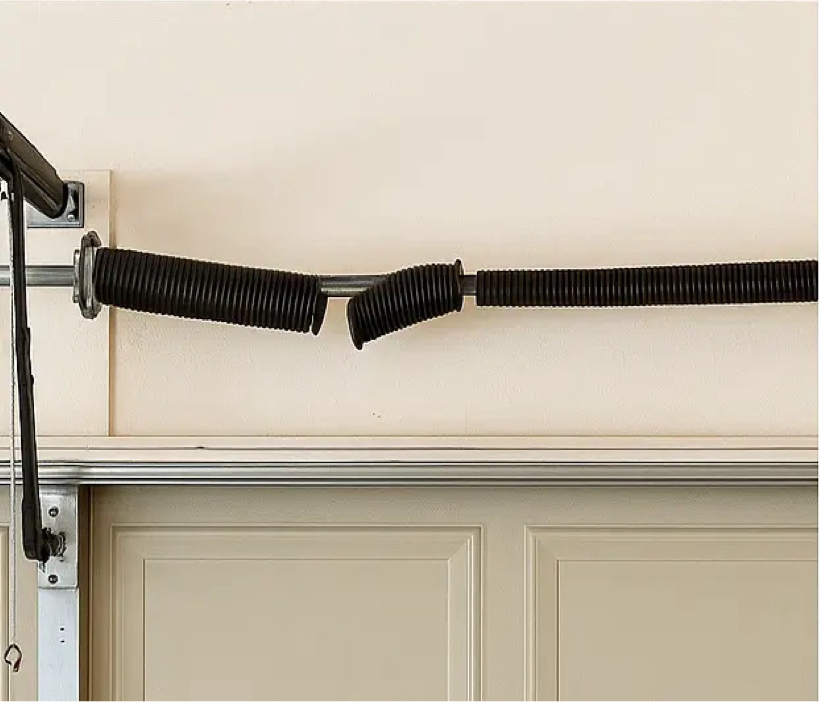
4. A torsion spring snapped (most common cold-weather failure)
This is the call we get most often in January. Steel torsion springs lose ductility as temperature drops — a spring that was just barely hanging on in October will snap on the coldest morning of the year. We see more spring failures in the first 10 days of January than in any other 10-day period of the year.
How to spot it:
- You heard a loud bang from the garage, often overnight
- The door feels extremely heavy or won’t lift at all
- The opener hums but the door doesn’t move (or barely moves)
- You can see a visible gap in the spring above the door
- The door starts to open and stops at about 6 inches
Don’t keep trying to force it. Each cycle with a broken spring puts the opener at risk of burning out or the second spring snapping. Disengage the opener with the red release rope and call us.
A spring snap is a same-day repair. We carry replacement torsion springs on every truck and most cold-weather calls are fixed within 90 minutes of dispatch. Our standard upgrade to 20,000-cycle high-cycle springs survives twice as many winters as the builder-grade originals.
5. The opener gear stripped from forcing past a stuck door
The cascade failure that follows when people don’t recognize signs 1–4. If you force the opener to fight a frozen seal, a heavy door from a weak spring, or a binding track in cold weather, eventually a small plastic gear inside the opener strips its teeth. After that, the motor spins but the chain or belt doesn’t move.
How to spot it: Motor sounds like it’s running normally — maybe even faster than usual — but the door doesn’t move at all. No grinding from the door itself. You may hear a slight clicking inside the opener housing.
What to do: Stop trying. The opener needs to come down for a gear replacement (usually a $40 part and 45 minutes of labor) or, if the motor was damaged too, a full opener swap. Don’t ignore it — the longer you run a stripped opener, the more risk of motor damage.
What to do tonight if you can’t open your garage
If it’s after-hours and you can’t get the door open:
- Pull the red emergency release. Now you can move the door manually.
- Lift the door slowly and steadily. If it feels heavy, stop — your spring may be failing, and a partially-open door under broken spring conditions can come down hard. Prop it with a sturdy support if you must leave it open.
- If you got the door fully open, leave it open if your car is inside the garage. Closing it manually and then needing to open it manually again in the morning isn’t worth the risk of jamming the bottom seal again.
- Lock the interior door from the garage into your house. Many people forget the garage door isn’t your only line of defense.
- Call us in the morning (or right now — we have 24-hour dispatch).
How to winter-proof your garage door in November
The best repair is the one you never need. In late October or early November:
- Lubricate everything with garage-door silicone spray (rollers, hinges, springs, cables, tracks)
- Check spring balance — disengage the opener, lift the door by hand, confirm it stays up at half height
- Replace cracked or rotted bottom seal before the first freeze
- Run an annual safety check on photo-eye sensors, force settings, and reverse sensitivity
- Schedule a tune-up with a pro if your door is more than 5 years old and hasn’t had one — we offer free written tune-up quotes year-round
Cold weather is unforgiving on garage doors, but most of the failures we see were predictable in August. Want a pre-winter tune-up? Call (855) 634-5995 or get a free estimate.