
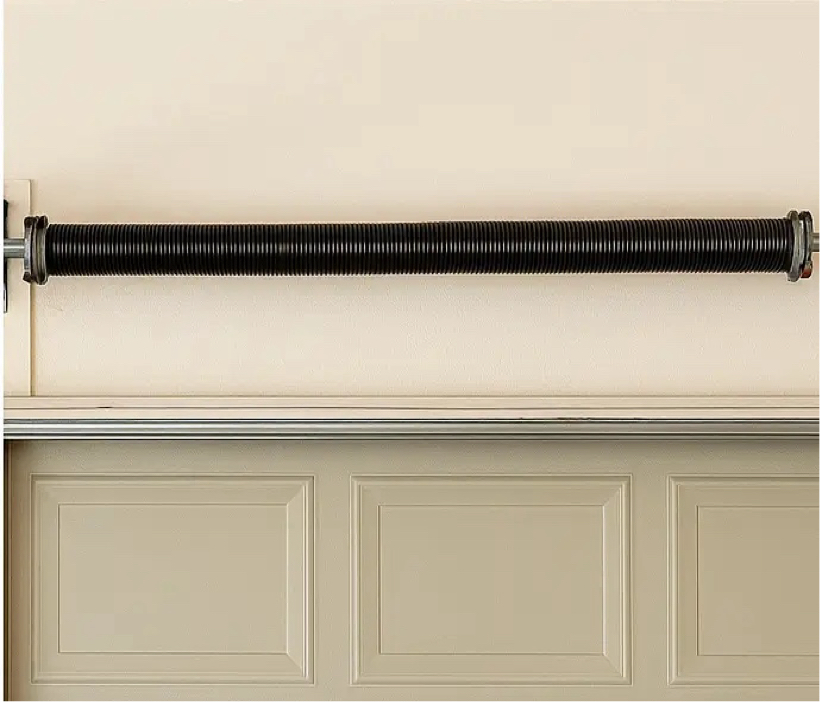
There’s a number every homeowner deserves to know about their garage door, and almost nobody does: how many more cycles your spring has left.
Garage door springs are not measured in years. They’re measured in cycles — one cycle is the door going up and one cycle is the door going down. Builder-grade springs, the kind installed on virtually every new home and most replacement doors, are rated for 10,000 cycles. That sounds like a lot until you do the math.
An average family opens and closes the garage door 4 times a day: out for work, back from work, out for an errand, back from the errand. That’s roughly 1,500 cycles a year. A 10,000-cycle spring lasts that family about 6.5 years. A two-driver household with kids in sports? Often 4 years. A retiree who only opens the door once a day? Sometimes 15 years.
This is why generic “how long do garage door springs last” answers on the internet are useless. The real answer depends entirely on your cycle count.
The cycle ratings explained
When a garage door spring is manufactured, it’s rated by how many compression cycles it can perform before metal fatigue causes the steel coils to lose tension and eventually snap. Here are the common ratings:
- 10,000 cycles — builder-grade. The cheapest option, installed in 95% of new construction.
- 20,000 cycles — the most common upgrade. About 2× lifespan, typically $20–40 more per spring at install time.
- 25,000 cycles — high-cycle, common for busy households.
- 50,000 cycles — extreme-cycle, used for commercial applications and homes with extra-heavy custom doors.
At Garavex we upgrade to 20,000-cycle springs on every spring replacement at no extra charge. We’ve never charged a customer more for a spring that lasts twice as long — it’s the only honest thing to do.
How to calculate where your spring is in its life
If you know roughly how many times you use your garage door per day, you can estimate:
| Daily cycles | 10,000-cycle spring | 20,000-cycle spring |
|---|---|---|
| 2 (one car, retired) | ~14 years | ~27 years |
| 4 (average family) | ~7 years | ~14 years |
| 6 (busy household) | ~4.5 years | ~9 years |
| 10 (multiple drivers / teens) | ~2.7 years | ~5.5 years |
So if you bought your house 8 years ago and the door has the original builder-grade spring, and you have two working adults each using the garage twice a day, you are on borrowed time right now. Today is a good day to schedule a spring replacement before it fails on a workday morning.
The 6 warning signs your spring is about to break
A torsion spring almost never fails completely without giving you signs first. Here’s what to look for:
1. The door feels heavier than it used to
Pull the red emergency release rope on your opener and try to lift the door manually. A balanced door with healthy springs should be liftable with one or two fingers and should stay open at any height. If yours feels heavy or wants to fall closed, the spring is losing tension. Time to call.
2. The opener struggles or pauses mid-lift
The opener is meant to guide the door, not lift its full weight (200–400 pounds for a typical residential door). If your opener is straining, humming louder than usual, or pausing halfway up, the spring isn’t doing its job. Every cycle in this condition shortens the opener’s life.
3. You can see a visible gap in the spring
Look at the spring above the door (you may need a flashlight). A healthy spring has tight, evenly-spaced coils. A spring that has lost tension or partially separated will show a visible gap somewhere along its length, often near the cone. This is days-away-from-breaking territory.
4. The door comes down too fast when released
If you disengage the opener and the door slams shut instead of slowly lowering itself, the spring is no longer holding the door’s weight. This is dangerous — a door coming down at speed can injure a child or pet.
5. The door is crooked or hangs at an angle
On a two-spring system (most modern doors), if one spring weakens before the other, the door tilts to one side. This stresses the cables, the rollers, the tracks, and especially the bottom panel. Continuing to operate a crooked door usually means a much bigger repair bill later.
6. You hear popping, grinding, or growling from above the door
Springs sometimes “talk” before they fail. Coils slipping against each other, or rust biting at the steel, can make popping or growling sounds during operation. This is the spring telling you it’s near the end. Don’t ignore it.
Why we always replace both springs
On a two-spring door, when one spring breaks, we always replace both. Customers sometimes push back — “the other one’s still working, why pay for two?”
Because both springs were installed on the same day, both have done the exact same number of cycles, and both are made from the same steel batch. If one just failed, the other is days or weeks behind it. Replacing both:
- Saves you a second service call fee within the year
- Keeps the door balanced (one new spring + one old spring = uneven lift)
- Means we can warranty the whole system instead of half of it
It’s the recommendation every honest garage door tech makes. If someone offers to replace only the broken spring to “save you money,” they’re saving you nothing — you’ll be paying for the second one in a few months.
Can you replace a garage door spring yourself?
We have to be blunt: no, you should not. Torsion springs store enormous amounts of energy under tension — enough to break bones, knock out teeth, or in rare cases kill. The most common DIY injuries we see are:
- Slipped winding bar that whips back into the face or chest
- Cone failure during winding that sends shrapnel flying
- Spring snap during installation that catches a hand or arm
Professional installation is a small price for not being the next ER story. We replace 5–10 springs every day across all our service areas, with the right winding bars, drum brakes, and PPE. The job takes us about 60 minutes from arrival to a tested working door.
How to make your next spring last longer
When you replace springs, ask for high-cycle. The price difference at install time is minimal compared to what you’ll save by not having to do this again in 5 years. Beyond that:
- Lubricate the spring with light silicone spray twice a year. Rust is the #1 enemy of spring life — a thin coat of silicone prevents it.
- Balance check annually. Disengage the opener, lift the door, and confirm it stays open at half height. If it doesn’t, the spring is losing tension.
- Don’t ignore noises. Popping, grinding, or growling from above the door is the spring asking for help.
Want to know if your current spring is near end-of-life? We do free diagnostic visits and written quotes — no obligation. Call (855) 634-5995 or book online.